Why Backtesting Matters: Or, How I Stopped Trusting My Gut and Started Trusting Data
A non-developer's honest take on why backtesting is the most underrated skill in crypto investing — and what happens when you skip it.
More in Field Notes
- Keystroke Aura — How I Turned Typing Rhythm into a Personality Test
- Karpathy Tweeted an Idea. I Spent a Day Putting It in My Obsidian Vault.
- OpenAI Just Built a Plugin for Their Competitor's Tool. I Installed It.
- Molecule Me: Your Personality, Encoded in Chemistry
- I Actually Fixed Everything. Here's What That Looked Like.
A note on credentials: I am a Korea-licensed pharmacist, not a financial advisor or registered investment professional. Everything in this series documents my own backtesting experiments using publicly available price data. The figures here reflect algorithmic outputs, not professional financial analysis. Please consult a qualified financial advisor before making any investment decisions.
If you ever hear someone say:
"I just have a feel for the market."
Please smile politely, wish them well, and quietly walk the other direction.
Because I used to be that person.
And I paid for it. Not with dignity — with actual money.
💸 The Most Expensive Sentence in Investing
"I have a good feeling about this one."
That sentence has cost retail investors more money than any scam coin ever did.
A "good feeling" means you skipped validation. Skipping validation means you are betting on luck. Betting on luck is not investing. It is gambling with extra steps and a nicer UI.
This post is about backtesting — what it is, why it matters, and why ignoring it is basically volunteering to learn expensive lessons the hard way. (Already familiar with backtesting? Skip to what 8 years of Bitcoin data actually showed for the results.)
📖 What Even Is Backtesting?
I will keep this simple because I am not a quant.
You take a trading strategy, apply it to historical price data, and see if it would have actually made money.
That is it. That is the whole concept.
Example:
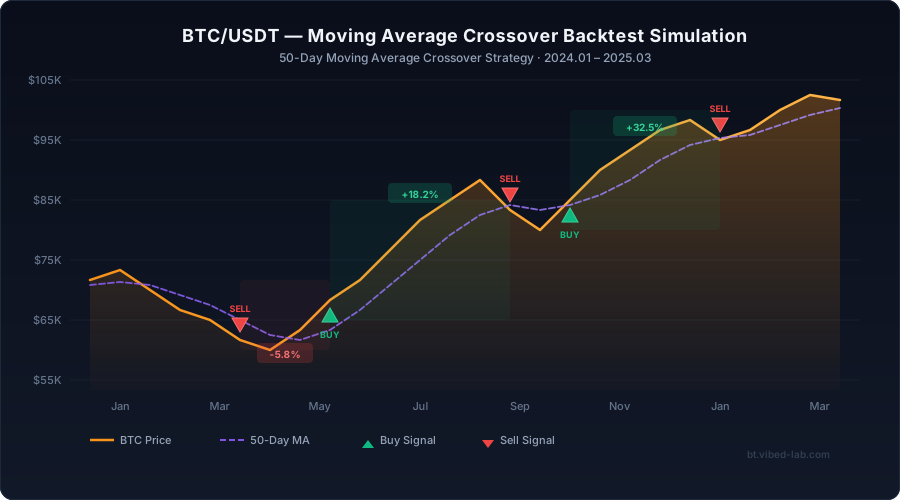
"Buy BTC when the price crosses above its 50-day moving average. Sell when it crosses below."
Sounds reasonable. But is it actually profitable?
Option A: Put real money in and find out over six months. (Terrifying.) Option B: Run it against three years of past data and find out in 30 seconds. (Smart.)
Option B is backtesting.
The chart at the top of this post visualizes exactly that. BTC price, 50-day MA, buy signals, sell signals, profit/loss zones. Everything you need to judge the strategy — before spending a cent.
When I first saw a backtest result laid out like that, my immediate reaction was:
"Wait... I could have just checked first?"
Yes. Yes, you could have.
🪤 Why Gut-Feel Trading Is a Trap
I am not going to lecture you about behavioral economics. I will just tell you what happened to me.
Your Brain Lies to You (Constantly)
Humans find patterns in random data. Scientists call this apophenia. Traders call it "my edge."
"Bitcoin always pumps on Mondays."
No, it does not. It pumped on three consecutive Mondays once, and your brain decided that was a law of nature. The twelve Mondays where it dropped? Your memory helpfully deleted those.
Backtesting does not have a memory bias. It just counts.
Emotions Make You Do the Opposite of What Works
Good strategy execution requires consistency. Emotions deliver the exact opposite of consistency.
Here is the emotional investor playbook:
- Winning → hold longer, get greedy
- Losing → panic, sell too early
- Market pumping → FOMO in at the top
- Market crashing → panic sell at the bottom
Congratulations, you just bought high and sold low. Repeatedly.
A backtested strategy removes this entirely. You already know when to enter, when to exit, and what to do when things go sideways. The decisions are made before the emotions show up.
Survivorship Bias Is Everywhere
You see the person on Twitter who made 1000% on Bitcoin. You do not see the nine people who lost 80% during the same period.
They went quiet. Nobody posts their L's.
When you trade on gut feel, you are calibrating your expectations against a wildly biased sample of outcomes. Backtesting shows you all the outcomes — the wins, the losses, and the boring middle where nothing happened for three months.
📊 What a Good Backtest Actually Shows You
Here is where it gets interesting.
A backtest does not just say "you made money" or "you lost money." It tells you how and why.
Total Return
The obvious one. How much did the strategy earn?
But this number alone is dangerously misleading. A 100% total return sounds amazing — until you learn there was a -70% drawdown in the middle.
Could you have held through -70%? Be honest. Most people cannot hold through -30%.
Maximum Drawdown
This is the number that actually matters for your sanity.
If $10,000 dropped to $3,000 at some point, your max drawdown was 70%. Final portfolio value of $20,000 means nothing if you would have panic-sold at $3,000.
I think of max drawdown as the "will I actually sleep at night" metric.
Backtesting shows you this number before you experience it with real money and real cortisol.
Win Rate and Risk-Reward Ratio
- 60 wins out of 100 trades → 60% win rate
- Average win: +5%, average loss: -3% → risk-reward ratio of 1.67
Here is the thing that broke my brain:
A low win rate with a high risk-reward ratio is profitable. A high win rate with a bad risk-reward ratio loses money.
You literally cannot intuit this. You need numbers.
Sharpe Ratio
Risk-adjusted return. The adult version of "how much did I make."
Strategy A: 20% annual return, 20% volatility. Strategy B: 15% annual return, 5% volatility.
Your gut says A is better. Your gut is wrong. B is significantly better.
Without backtesting, you would never know.
🚨 Real Scenarios Where Skipping Backtesting Hurts
These are not hypotheticals. I have seen all of these happen.
"I Saw It on YouTube"
"This trader said RSI + MACD combo is unbeatable."
So you followed it. Won three times. Got confident. Lost big on the fourth. "Bad timing." Lost on the fifth. And the sixth.
Turns out the strategy only worked in the 2021 bull run. In sideways or bear markets, it slowly bled money.
If you had backtested across multiple market conditions, you would have seen this in 30 seconds.
Instead, you learned it over six months. With real money.
"My Own Brilliant Rule"
"Buy when BTC drops 5% in a day. Sell when it goes up 10%."
Sounds rational. Clean. Simple.
But what happens when it drops 5% and then drops another 30%? What happens when it goes up 10% and then goes up another 100%?
"Sounds reasonable" and "actually makes money" are two very different things. Backtesting tells you which one you are looking at.
"Everyone Else Is Making Money"
Late 2024. Bitcoin at all-time highs. Your timeline is nothing but screenshots of gains.
FOMO kicked in. You bought near the top. Correction came. You panic-sold.
Classic.
If you had a backtested strategy, you would have known: "Current conditions do not meet my entry criteria." You would have stayed out. Or entered with a predefined plan and a stop-loss that did not involve your emotions.
⚠️ The Honest Limits of Backtesting
I am not going to pretend backtesting solves everything. It does not.
Overfitting
If you tweak a strategy until it perfectly fits historical data, it will almost certainly fail in the future.
It is like memorizing an answer key. Same test? Perfect score. Different test? Disaster.
Simple strategies with fewer parameters tend to generalize better. The fancier your backtest looks, the more suspicious you should be.
Slippage and Fees
Backtests assume perfect execution. Reality does not.
- Orders slip. You wanted $65,000 but got filled at $65,040.
- Fees add up. Especially if you trade frequently.
- Large orders move the market.
A good backtest accounts for this. A bad backtest pretends it does not exist.
Past ≠ Future
A strategy that crushed it from 2020–2024 might fail in 2025.
But here is the thing: this is not a flaw of backtesting. This is the nature of investing itself.
Backtesting is not a crystal ball. It is a history book. And people who refuse to read history tend to repeat the worst parts of it.
🚀 Getting Started (Without a CS Degree)
When I first heard about backtesting, I assumed I needed to know Python.
That stopped me for months.
Then I realized: the hard part is not running the simulation. The hard part is defining the strategy clearly enough to run one.
"I kind of want to buy when the price dips and sell when it recovers" is not a strategy. It is a vibe.
You need:
- Entry rules — exactly when you buy
- Exit rules — exactly when you sell
- Position sizing — how much per trade
- Risk management — where your stop-loss sits
If you can code, tools like backtrader or zipline in Python work great.
But if you cannot code — and I could not — that is a problem.
That is why we built CryptoBacktest.
CryptoBacktest: The Part Where I Shamelessly Plug Our Own Tool
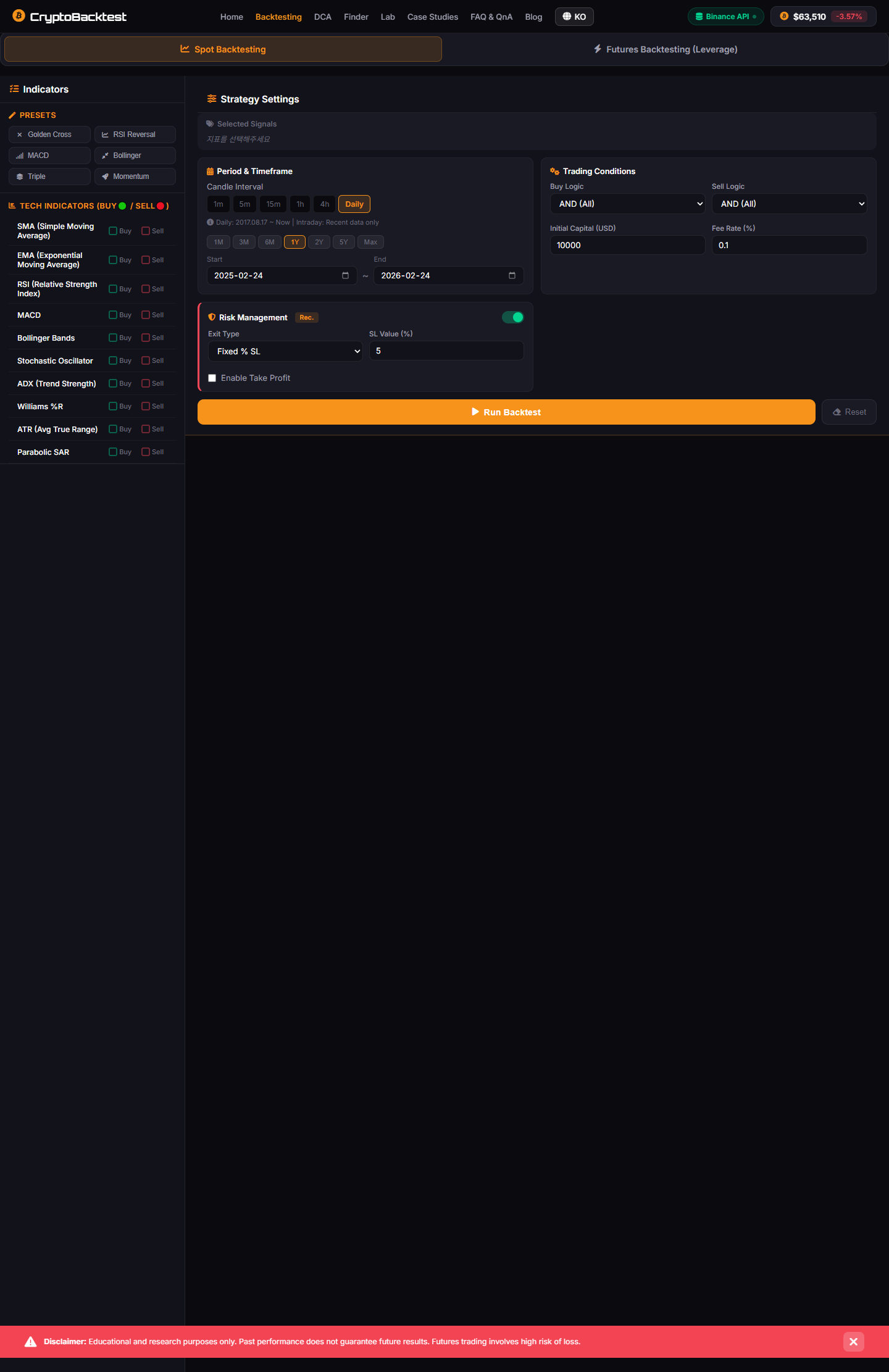
Okay yes, this is a plug. But hear me out, because the reason we built this is directly connected to everything above.
Most backtesting tools assume you already have a perfectly defined strategy.
You do not. I did not. Nobody does on day one.
You have a vague idea. A hunch. "Something with moving averages and maybe RSI?" That is a starting point, not a strategy.
This is the part that makes CryptoBacktest different from everything else I tried.
You describe your trading idea in plain language, and the AI helps you formalize it into actual entry/exit rules, position sizing, and risk parameters. It turns "I have a vague idea" into "I have a testable strategy" — without writing a single line of code.
That is it. That is the killer feature. You do not need to be a quant to think like one.
What you get:
- AI-assisted strategy building — describe your idea, get a structured strategy back
- No code, no setup — runs entirely in the browser
- Multiple strategy types — MA crossover, RSI, DCA, and more
- Realistic simulations — against actual historical data
- Full reports — returns, max drawdown, win rate, trade-by-trade breakdown
Try it at bt.vibed-lab.com.
The hardest part of backtesting was never the simulation. It was defining the strategy clearly enough to run one. AI solved that for me.
💡 One Last Misconception to Kill
Backtesting does not make investing easy. Backtesting does not guarantee profits.
What it does:
- Filters out bad strategies before you lose money on them
- Shows you what a strategy actually looks like across different markets
- Moves your decision-making from emotion to data
- Lets you experiment for free instead of paying tuition with real capital
This is not "guaranteed success." This is "systematic failure reduction."
And in investing, reducing your failure rate systematically is the most powerful edge that exists.
Gut Feel vs. Backtested — A Brutally Honest Comparison
| Gut-Feel Investing | Backtest-Based Investing |
|---|---|
| "I have a feeling" | "The data says yes" |
| Actions shift with mood | Same rules, every time |
| Win and have no idea why | Win and know exactly why |
| Lose and blame the market | Lose and fix the strategy |
| Repeat mistakes forever | Learn, adjust, improve |
🎯 Final Thought
The most expensive education in investing is the one paid with real money.
Backtesting brings that tuition cost close to zero.
The past does not guarantee the future. But someone who refuses to learn from the past has even worse odds going forward.
If you have a strategy, test it first. If you do not have a strategy, build one — then test it. If the test says it is bad? That is not failure. That is finding out before real money was on the line.
That is the value of backtesting. That is why we built CryptoBacktest.
And yes, I still wince when I think about the trades I made before I discovered it.
Written by
Jay Lee
Korea-Licensed Pharmacist (#68652) · Senior Researcher
Korea University, College of Pharmacy (B.S. + M.S., drug delivery systems & industrial pharmacy). Building production-grade AI tools across medicine, finance, and productivity — without a CS degree. Domain expertise first, code second.
About the author →Related posts