Playground Is Live: The Destiny Grid, Real Astrology, and Why I'm Shipping a Toy Every Month
Vibed Lab's Playground section is officially live — and the first toy is a fortune grid that maps your entire life to colored squares using real planetary cycles. Here's what's actually under the hood: Jupiter returns, Saturn cycles, Chiron wounds, and why your birth latitude matters more than you'd think.
More in Field Notes
- Keystroke Aura — How I Turned Typing Rhythm into a Personality Test
- Karpathy Tweeted an Idea. I Spent a Day Putting It in My Obsidian Vault.
- OpenAI Just Built a Plugin for Their Competitor's Tool. I Installed It.
- Molecule Me: Your Personality, Encoded in Chemistry
- I Actually Fixed Everything. Here's What That Looked Like.
I built a toy.
Not a product. Not a SaaS. Not something with a pricing page and a Stripe integration. A toy. A colorful, interactive, completely useless-in-the-economic-sense thing that takes your birthday and turns your entire life into a grid of colored squares.
It's called the Destiny Grid, and it's the first thing living inside Vibed Lab's new Playground section.
And honestly? I had more fun building this than anything I've shipped in months.
🎨 What Even Is the Playground?
Every product I've built so far — VORA, PK-Swift, CryptoBacktest — exists to solve a real problem. Meeting transcription. Pharmacokinetics. Crypto strategy validation. They have users, roadmaps, and the constant background hum of "is this good enough yet?"
The Playground is the opposite of that.
It's a space for things that don't need to justify themselves. Small, visual, interactive experiments. No monetization strategy. No user acquisition funnel. Just... stuff I think is interesting to build and fun to share.
I got the idea from watching people share personality quizzes and zodiac memes on Twitter. Those things spread because they're personal, visual, and low-commitment. You tap a link, you see something about yourself, you screenshot it and share. Nobody needs a 14-day free trial to try a personality quiz.
So I thought: what if I built things like that, but with actual substance underneath?
The plan — and this might change, because plans always do — is to ship one new toy every month. A "Toy of the Month," if you want to call it that. Some months it might be an astrology thing. Other months it might be a data visualization, a mini-game, a generative art tool. Whatever catches my curiosity that week.
The Destiny Grid is Toy #1.
🖼️ The Destiny Grid: What You See
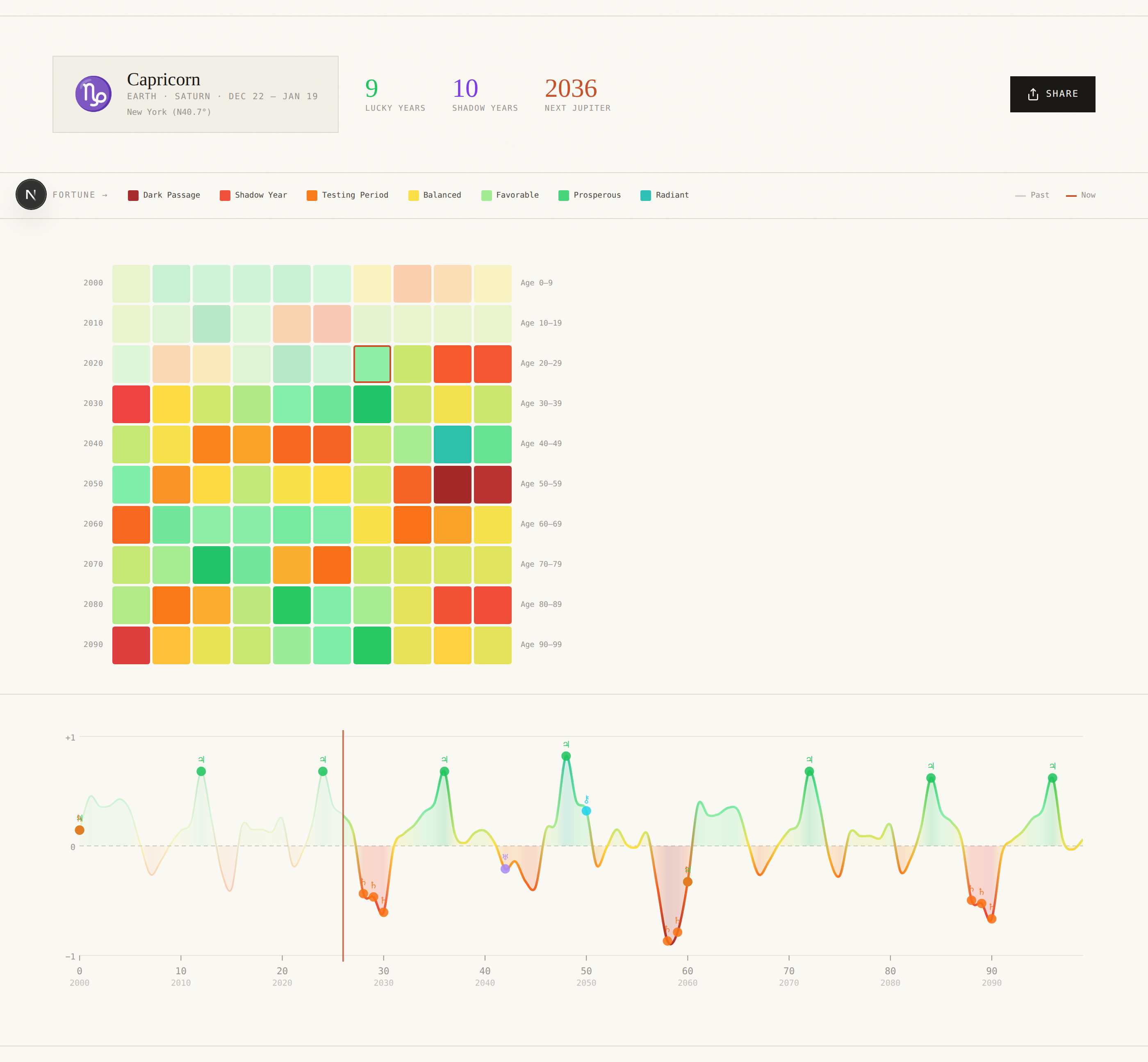
You enter your birth date and birthplace. You click "Reveal My Grid." And your entire life — from birth to age 100 — unfolds as a 10-column grid of colored squares.
Each square is one year of your life.
The color tells you the fortune score for that year: dark crimson for the hardest years, through orange and yellow for neutral territory, up to bright green and sky blue for peak years. Years you've already lived appear faded. The current year gets a highlighted border.
Below the grid, a Catmull-Rom spline chart draws the same data as a continuous wave — peaks and valleys across your lifespan, with planetary symbols marking the major transit events.
It's pretty. People screenshot it. That was the whole design goal.
But the interesting part — the part I actually want to talk about — is what's generating those colors.
🧠 The Astrology Under the Hood
I need to be upfront about something: I didn't know any of this before I built it.
I went in thinking astrology was basically "you're a Scorpio, so you're intense." Sun sign columns in magazines. Personality stereotypes. That's what most people think it is, and honestly, that's what I thought too.
Then I started reading about planetary cycles, and I fell down a rabbit hole that I'm still not fully out of. What I found is that traditional astrology — the kind practiced for thousands of years, not the kind on Instagram — is less about personality and more about timing. Cycles. Seasons of a life.
The Destiny Grid uses six real astrological techniques. Here's what each one actually does.
🪐 1. The Jupiter Cycle (12 Years)
Jupiter takes about 11.86 years to orbit the Sun — which astrologers round to 12. Every 12 years, Jupiter returns to the exact position it held when you were born. This is called a Jupiter Return, and in traditional astrology, it marks a period of expansion, opportunity, and luck.
The Destiny Grid tracks a 12-phase cycle:
- Jupiter Return (ages 0, 12, 24, 36, 48...): Peak expansion. Score boost of +0.52.
- Jupiter Opposition (~6 years after return): A period of reflection and tension. Score dip of -0.12.
- The phases between follow a smooth curve: momentum builds as you approach the next return, wanes after you pass it.
But here's the interesting part. Each zodiac sign has a personal Jupiter offset. Aries resonates at phase 0. Taurus at phase 2. Scorpio at phase 3. This means your personal "lucky years" shift depending on your sign.
When I first read about Jupiter Returns, my immediate reaction was skepticism. Then I looked up the ages: 12, 24, 36, 48. Twelve is when most kids start forming real independence. Twenty-four is when careers take shape. Thirty-six is often a professional peak. The pattern maps surprisingly well onto common life milestones.
Coincidence? Probably. But it's a neat coincidence.
🪨 2. The Saturn Cycle (29.5 Years)
If Jupiter is the expansion planet, Saturn is the contraction planet. Saturn's orbital period is roughly 29.5 years, and its cycle is the backbone of traditional life-stage astrology.
The big events:
- Saturn Return (~age 29-30): The most famous transit in astrology. It's when Saturn completes its first full orbit since your birth and "returns home." In traditional practice, this marks a period of reckoning — career upheaval, relationship crises, identity questions. It's the astrological explanation for why your late twenties feel like an existential blender.
- Saturn Opposition (~age 14-15): Half a Saturn cycle. Structural pressure. Adolescence, basically.
- Saturn Squares (~ages 7-8, 21-22): Minor challenge points. Growing pains.
The Destiny Grid models this as a 30-phase score curve. But it adds a crucial twist: Saturn sensitivity per sign.
Not every sign feels Saturn equally. Capricorn (ruled by Saturn) and Cancer (Saturn's detriment sign) have the highest sensitivity — a multiplier of 1.4 and 1.2 respectively. When Saturn hits them, it hits hard. Sagittarius, with a sensitivity of 0.65, breezes through comparatively unbothered.
This means two people born in the same year but under different signs can have dramatically different grid colors at age 29. That's not a bug — it's how traditional astrology actually works. The same transit affects different charts differently.
I'll be honest, I spent an unreasonable amount of time fine-tuning these sensitivity values. The first version had Capricorn's Saturn Return scoring -0.62, which turned their entire late-twenties row blood red. Looked dramatic. Also looked broken. I dialed it back.
🌌 3. The Uranus Opposition (~Age 42)
Uranus takes about 84 years to orbit the Sun. At age 42 (give or take), it sits exactly opposite its birth position. Astrologers call this the Uranus Opposition, and it's essentially the astrological framework for the midlife crisis.
The grid applies a score penalty of -0.22 in a window around ages 40-44, peaking at 42. The intensity formula uses a simple linear falloff:
intensity = 1 - |age - 42| × 0.4Short window. Sharp dip. If you've ever wondered why 42 keeps showing up as a culturally significant age — Douglas Adams aside — this is one possible lens.
💔 4. The Chiron Return (~Age 50)
This one surprised me the most.
Chiron is a minor celestial body (technically a "centaur" — half asteroid, half comet) orbiting between Saturn and Uranus. Its orbital period is roughly 50 years. In astrology, Chiron is called the Wounded Healer: it represents your deepest wound and your capacity to heal others through that wound.
At around age 50, Chiron returns to its birth position. The Chiron Return is interpreted as a moment when old emotional wounds resurface — but with the wisdom and distance to actually process them.
The Destiny Grid handles this with an element-specific response:
- Water signs (Cancer, Scorpio, Pisces): +0.10 bonus. Deep healing. The wound becomes a gift.
- All other signs: -0.10 penalty. The wound resurfaces and stings.
I debated whether to include Chiron at all. It's more obscure than Jupiter or Saturn. Most casual astrology ignores it. But it creates a meaningful color shift around age 50 that looks right — a small, quiet event between the louder transits on either side. It earned its place.
🔄 5. The Second Saturn Return (~Age 59)
Saturn comes back around again. If the first Saturn Return at 29 was about "who am I becoming?", the second at 59 is about "what am I leaving behind?" Legacy. Mortality. The score penalty is -0.28, multiplied by the same sign-specific sensitivity. Capricorns get hit hard again. Sagittarius barely notices. Some things never change.
🌍 6. Latitude and Seasonal Modifiers
This is the part nobody expects.
Your birthplace coordinates — specifically your latitude — affect the fortune calculation. The logic models how extreme your local seasons are:
- Born above 50° latitude (Stockholm, Helsinki)? Strong seasonal swing. Amplifier of 0.08.
- Born between 30° and 50° (New York, Tokyo)? Moderate swing. 0.04.
- Born near the equator (Singapore, Nairobi)? Almost no seasonal effect. 0.01.
The birth month determines which phase of the seasonal cycle you start in, and the hemisphere flips it — southern hemisphere births get an inverted seasonal curve.
There's also a subtle bonus for high-latitude births at every fourth year (age divisible by 4), which loosely models the traditional astrological idea that Earth's axial relationship to outer planets creates micro-cycles at those latitudes.
Is this "real" astrology? Honestly, it's the most speculative part. Traditional astrology cares deeply about birth location for calculating houses and ascendants — which the Destiny Grid doesn't do — but the latitude-as-seasonal-amplifier idea is more of a creative interpretation than a strict classical technique. I included it because it makes the grid more personal: two people born on the same day in New York and in Bangkok get slightly different maps. That felt right.
⚠️ What It Isn't
The Destiny Grid is not a natal chart. It doesn't calculate your rising sign, moon sign, planetary houses, or aspects. It doesn't know where Mars was when you were born or which house your Venus sits in.
A full natal chart is a complex, multi-layered reading that requires exact birth time (not just date) and precise astronomical ephemeris data. That's a different product entirely — and one that already exists in many forms.
What the Destiny Grid does instead is take the time-based cycles of traditional astrology — the ones that depend only on birth date and location — and visualize them across an entire lifetime. It answers "when" more than "who."
There's a disclaimer right in the UI: "For reflection and entertainment — not prediction." I mean it. But I also think there's something genuinely interesting about seeing your entire life reduced to a pattern of colors and realizing that the peaks and valleys have a rhythm to them.
🔥 The Element × Year Affinity
One more thing I wanted to mention because I find it oddly satisfying.
Each zodiac element (fire, earth, air, water) has a subtle affinity with the calendar year, cycling every four years:
| Year % 4 | Fire | Earth | Air | Water |
|---|---|---|---|---|
| 0 | — | +0.10 | -0.05 | — |
| 1 | +0.10 | — | — | -0.04 |
| 2 | — | +0.04 | +0.10 | — |
| 3 | -0.05 | — | — | +0.10 |
It's a small effect. You won't see it dominate any single cell. But over a 100-year grid, it creates a subtle four-year pulse in the color pattern — a kind of background heartbeat underneath the larger planetary cycles. Look closely at the grid and you can see it: a faint diagonal rhythm running through the decades.
🎯 Try It Yourself
The Destiny Grid is live at vibed-lab.com/playground/destiny-grid.
Enter your birthday, pick your city, and see what your life looks like as colors. Screenshot it. Share it. Send it to someone and argue about whether their Saturn Return was really as bad as the grid says.
And if the grid shows dark red at your current age — don't panic. Saturn always moves on eventually.
🚀 What's Next
The Playground is just getting started. The plan is one new toy per month — though honestly, the cadence might vary depending on what I'm building on the product side. Some months might bring two. Some might skip. But the intent is there: a regular stream of small, visual, shareable things.
I have a few ideas already sketched out. None of them are serious. All of them are fun.
See you next month.
Update — 2026.03.14: The Destiny Grid now has an Eastern tab — 四柱八字 Saju. Four Pillars, Five Elements, 大運 and 歲運. I wrote a whole post about what I learned building it: The Destiny Grid Gets Its East Wing: I Rebuilt Saju (四柱八字) in TypeScript.
2026.02.28
Written by
Jay Lee
Korea-Licensed Pharmacist (#68652) · Senior Researcher
Korea University, College of Pharmacy (B.S. + M.S., drug delivery systems & industrial pharmacy). Building production-grade AI tools across medicine, finance, and productivity — without a CS degree. Domain expertise first, code second.
About the author →Related posts